FIVE TIPS TO IMPROVE YOUR SCRABBLE
by Calum Edwards (Coach of 2014 World Youth Scrabble Champion - Jack Durand)
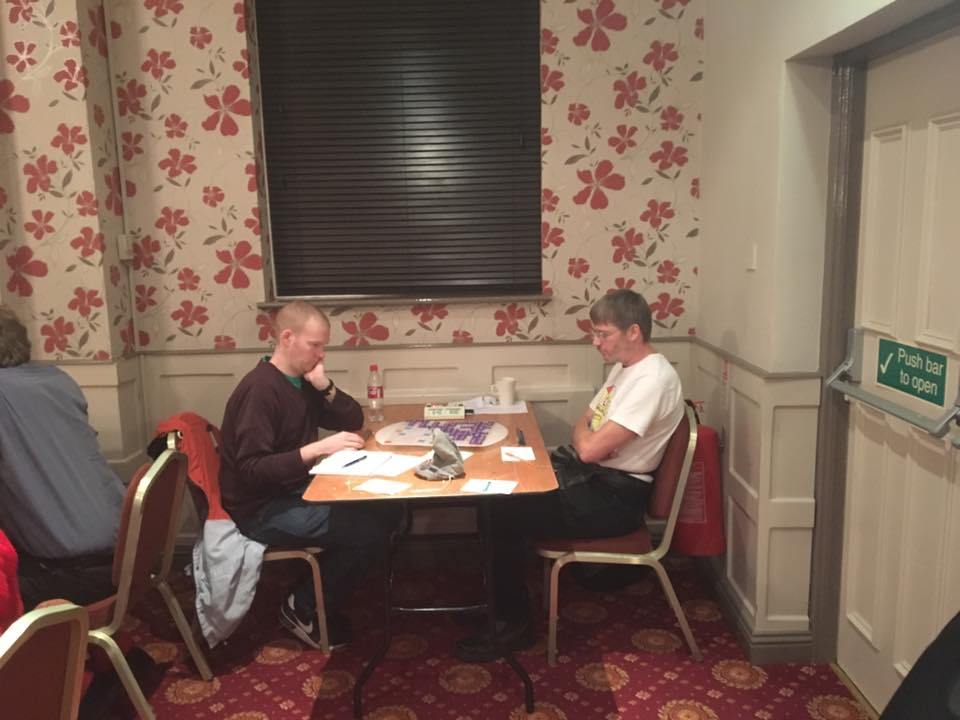
In this post I am going to be looking at five ways to help you win at Scrabble by improving your play. I may expand on some of these things in later articles but for now I am just doing a brief introduction on how to get started and also to give a little bit of information for how to take things further on your own.
1. Learn the words
Unfortunately, there is no getting around it, in order to improve your level of play you need to learn as many words as you can. So where do you start? Firstly, it is important to know which word list to learn as different lists/dictionaries contain different words. For tournament Scrabble play, the main word list used in most of the world is Collins Official Scrabble Words. (usually known as CSW)
Outside of North America this is used pretty much everywhere except for a few enclaves where the American word list is in use. It is also constantly gaining popularity in North America as well. This is the list that I would advise learning from.
So, do you just start on the first page at A and keep reading till you get to Z? No, I would advise being a bit more systematic with your learning than that. The first thing to learn is the two letter words, the next thing would probably be the three letter words. These two lists are both relatively small and with a bit of practice and repetition it is possible to remember them all, especially the twos.
After you have got through the 2’s and 3’s, which are the basic building blocks of the game it might be worth learning some high probability 7’s and 8’s. By “high probability” I mean words which are the most likely to come up during a game, usually words which contain the most common letters in the game. RETAINS for example contains common letters. That is far more likely to appear on your rack than something like MUUMUUS. If you consider that there are only two M’s in the game and only 4 U’s, the chances of having all those tiles on your rack at the same time are quite slim. It has never happened to me in the thousands of games I have played. I have had the letters for RETAINS loads of times.
There is software available that can help you make lists of words in probability order and to do anagramming quizzes. The most widely used and most easily available of these is Collins Zyzzyva which is available to download as the third item down on that link. Once you have done a few high probability 7’s and 8’s, it might be time to learn a few 4’s and 5’s with the power tiles (J,Q,X.Z) You can really do as little or as much study as you like. However, the more you do the better you will get.
Basic tip – Learn the 2 letter words.
Further work – Keep learning words.
2.Rack Balancing
How often do you find yourself in the frustrating position of having too many of one letter? Or do you often find that you have a rack that contains too many vowels or too many consonants? This can happen by accident but quite often it is preventable.
Whenever you play a move you have options of which tiles you keep and which tiles you play on the board. If possible you should try to keep a balance of vowels and consonants on your rack. If your rack is AEEETUV and you play VET, your rack leave is AEEU. You have left yourself four vowels, this is asking for trouble on your next rack. If you play EAU (which is allowable) you would leave yourself EETV which is a much better balance.
It is the same with consonants. If you have ACEHMTV. Don’t play something like ACE and leave yourself HMTV, play something like CHAV and keep EHM or MATCH leaving EV.
It is worth learning a few words that are consonant or vowel “heavy” to get you out of trouble when you do find yourself with an unbalanced rack. Things like EAU or EUOI or even EUOUAE. Those are all valid words. With consonants words like HMM and CRWTH can come in handy.
Summary.
Basic tip – Try to keep a balance of vowels and consonants.
Further work – Learn vowel and consonant “heavy” words.
3.Rack Equity
This follows on nicely from rack balance. There are certain tiles that are worth keeping on your rack to sacrifice a few points of score. There are also certain combinations of tiles which you might want to keep together because they go well together.
I am not going to go too much into the mathematical side of this as it is quite complicated. It is something that you may want to look into for yourself as you progress at the game. Here I am just going to mention a few of the basics.
The blank is the most valuable tile in the game. If you have a blank on your rack, you should usually not be playing it unless you can score at least 25 points more by using the blank than by not using it. I personally would err more towards 30. So for example if you have a move that scores 35 which uses the blank and a move that scores 20 that does not use the blank, you should take the 20 points and keep the blank. It is not worth sacrificing it for the extra 15 points. Ideally you should be looking to get a 7 or 8 letter word with your blank to get 50 bonus points.
The next most valuable tile is the S. You should usually not be using an S unless you can score something like 10 points more by using it than by not using it. An exception to this rule might be if you have more than one S in which case you might use one of them reasonably cheaply. Other tiles that are considered good to hold onto but are not as valuable as blanks and S’s are Z,R,N,T,C and E but you would sacrifice far fewer points to hold onto any of those tiles than you would a blank or S.
There are also tiles that you should get rid of as soon as possible and that it might be worth scoring a few points less on a turn in order to do so. The Q is the best example of this. It could be worth sacrificing as much as 10 points to be rid of that. U,V and W are other tiles that are not good to keep on your rack.
As mentioned above though there are some combinations of tiles that go well together, for example the Q on its own is a bad tile to keep, so is a U on it’s own but together they work well.
There are a lot of combinations of tiles that are very strong together. There are also combinations that are very weak. These are often obvious. AERT is nice. HHVV is not. It is rarely considered good to have two of the same tile and it is worth splitting them up if this happens. For example, if you have two T’s on your rack it would usually be best to use at least one of them on your next turn even though one on it’s own is a reasonably good tile to hold on to.
The cross-tables leave evaluator is a good tool to help you look into this further. (make sure you set it to CSW if that is the dictionary you are using, the default is TWL which is the American list)
Basic tip – Hold on to a blank until you can use it to score heavily.
Further work – Use cross tables to investigate further.
4.Tile Tracking
Tile tracking is an integral part of playing Scrabble to a high standard. Very few players playing in the upper divisions of Scrabble tournaments do not tile track. Tile tracking is simply using a sheet with all 100 tiles displayed on it and crossing off each one as it is played on the board. That way you should know which tiles are still to come.
Probably the main reason that this is a useful thing to do is that once the bag is empty you can cross off the tiles that still remain on your rack and you should then know which tiles your opponent has left and from there you should be able to predict how the rest of the game will pan out. “What can they do with what they have got?” “What can I do to counter them?”
You may find, for example, that they have the Q and there is only one spot to play it which you can block. Tracking can make a vital difference in a close game.
Tracking is also useful throughout the game, becoming more and more useful as you head towards the end. As the tile pool diminishes, it enables you to spot trouble ahead. Are there tricky tiles unseen like the Q or the V’s which might be difficult to get rid of on a tight board. Are there a lot of vowels still to come? In which case you may want to hold on to your consonants. Or maybe it is the other way round, the bag is full of consonants so you need to keep vowels.
Basic tip – Tile track
Further work – Keep doing it
5.Learn From Mistakes
I have to admit I am bad at this. When I miss words or make tactical errors I feel like giving up but it is possible to use your mistakes to improve. Like most aspects of the game you can work on this as little or as much as you want.
One way to look for errors which is relatively easy is when you have a rack that you think should make a 7 letter word but are not sure write the rack down. you can use Zyzzyva to look it up later to see if there was anything there. Or maybe you have a word you are not sure of and you do not want to risk playing it in case you lose your turn. Write it down and look it up later.
If you want to take things even more seriously, there is computer software which can be used to analyse entire games. The most popular being Quackle which can be downloaded from the link. As well as being useful for analysing games Quackle also provides a tough computer opponent
Analysing games in this way is not for the faint-hearted for a couple of reasons. Firstly, in order to be able to do it, it requires that you write down all of your racks for the game and also all the words that both you and your opponent played during the game. You also need to know where on the board the moves were played.
This can be done with grid references, or you could have a printed sheet with a diagram of the board on it that you copy the words on to as you go or you could photograph the board at the end of the game. All of this is quite a bit of extra work, especially if you are playing to a time limit. I found when I first started doing this that it was best to practice doing it in non-timed games first before trying it out in tournaments.
The second reason why this can be a difficult process is because you will find a lot of mistakes in your game, especially to begin with. Also, no matter how many words you learn and how much you refine your play you will never be perfect.
Basic tip – Make notes during game. Check words later
Further work – Use Quackle to analyse games in detail
Anyway, I hope I have done what I set out to achieve which was to give you some ideas on how to improve. Some quite easy and basic and others which are a little bit more involved.
One last thing, relax and enjoy playing the game. It is likely that that will also help you to play better.